Sarah Ritter
Biography
Sarah Ritter
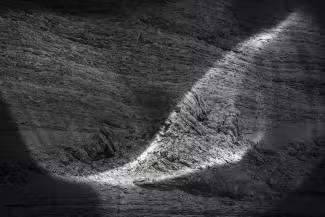
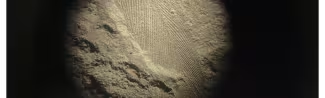
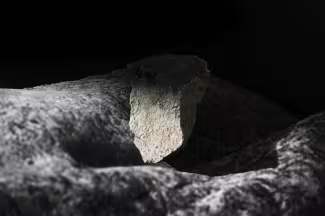
The Shadow of the Earth is a long-term project that originated in the exploration of contemporary knowledge production chains. The first chapter focused on research in optics, exploring light as a tool, as a subject of research, and as an industrial challenge.
“Laboratories” are viewed as spaces for staging, spaces for the production of fiction. A bridge has been built between oceanographic research and optical research. The “depths” of the ocean mirror the mountains, which rose from the bottoms of ancient oceans. Following “Light as Object,” the second chapter of The Shadow of the Earth will focus on the depths—both on land and at sea.
Photography has contributed to the effort to reduce the world to a calculable, quantifiable, homogeneous, and undifferentiated space. In this sense, it is undoubtedly one of the least suitable tools for creating a space that disrupts the capitalist order—for producing heterogeneity within a calculable and calculated space. But following Flusser, Sarah Ritter believes it is possible to use photography to open breaches, puncture maps, and obscure the transparent, digitized horizon.
Here, photography is a poetics of the gaze. How can photography offer the gaze movements other than those of a reassuring and confined recognition?
Like the first chapter, this one will draw on several sources and feature various collaborators, such as the Department of Oceanology at the University of Lille and its technology platform, the National Archives of the World of Work , and Elsa Dorlin, with whom the artist will travel to French Guiana, France’s leading region for contemporary mining.
Biography