Accessibility
Because photography concerns and involves everyone, a commitment to openness and accessibility guides the Institut pour la photographie's mission.
In its current form—beyond its walls—as well as in its future, the Institute is conceived as a place of hospitality and social interaction, where everyone can feel fully included.
The outreach projects carried out are specifically designed to address this concern for inclusion and this essential consideration of cultural rights. Its various initiatives have been tailored to people from diverse backgrounds and circumstances, whether they have a disability, speak a different language, or are vulnerable due to their life experiences. The exploration of diverse forms of expression is central to these efforts, whether through photography, movement, the senses, etc.
While the public often consists of visitors or spectators, the Institute wants them to play an active role in the projects it initiates. Workshops, fundraising drives, games, and various exhibitions and events help foster this collaborative and inclusive spirit.
To fulfill this mission, the Institut pour la photographie is constantly innovating and implementing a variety of tools and initiatives—both physical and digital—developed in collaboration with specialized partners.
With support from the Hauts-de-France DRAC and the Hauts-de-France Region.
In collaboration with Papillons Blancs de Lille, PAF—French Audio Description Professionals, Laville Braille, and Signe de Sens.
Photography credits: Claire-Marie Régent
Page content
FALC Booklets
Since 2024, for each exhibition organized by the Institut pour la photographie, a booklet written in FALC—easy to read and understand—has been made available to the public at the reception desk of the respective venue.
These FALC booklets are produced in collaboration with the association The White Butterflies of Lille .
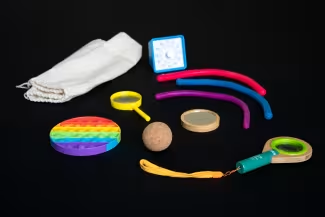
Sensory Kits
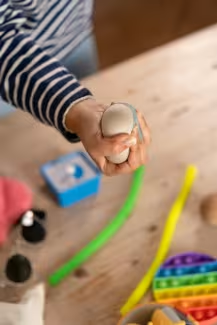
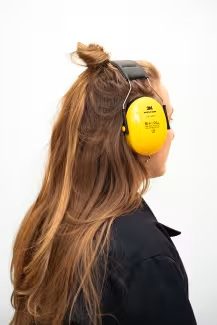
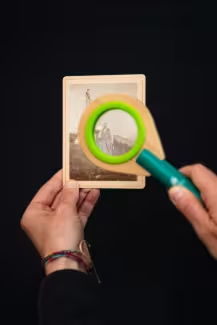
at the reception desk of each exhibition venue, the Institut pour la photographie provides visitors who are interested with sensory kits containing various objects and materials to touch and handle, thereby enhancing their experience and comfort during their visit.
The sensory kits include noise-canceling headphones, sunglasses, a magnifying glass, a timer, and stress-relief items to touch and handle.
Audio Descriptions
In close collaboration with the Belgian organization PAF - French-speaking audio description professionals — As part of each exhibition, the Institut pour la photographie continues to produce audio descriptions that visitors can access throughout the tour.
Audio description makes a variety of visual content—such as performances, movies, TV shows, photographs, and more—accessible to people who are visually impaired or blind.
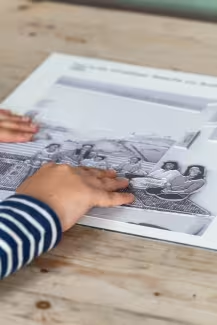
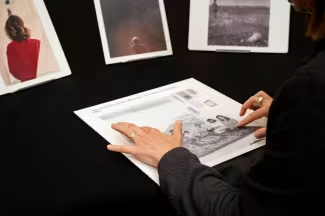
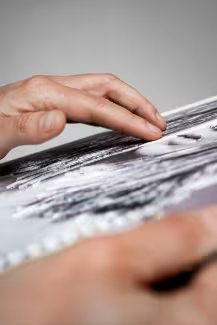
Tactile Images
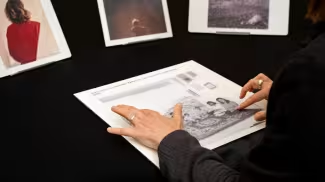
To improve accessibility, the Institute has been working since 2023, in collaboration with a specialized printing company, to Laville Braille , tactile photographs from his exhibitions.
These works superimpose a tactile translation onto an original photograph, so that people who are blind or visually impaired can experience and access it through another sense: touch. For everyone, tactile photographs also offer the opportunity to engage with and explore images in a different way—using our palms and fingers.
Since the start of the 2024 school year, at least one tactile photograph has been made available to the public as part of each scheduled exhibition.
Tours in Sign Language
To support people with hearing impairments, tours in French Sign Language are offered in partnership with the association Signs of Meaning , for each program.
Descriptive Tours
Descriptive tours allow visitors to explore an exhibition through the lens of audio descriptions delivered in a lively, spontaneous, and interactive way.
Designed specifically for people with visual impairments, these tours are also open and accessible to everyone.
Mobile-friendly website
As part of the redesign of its website, the Institut pour la photographie has made it a priority to ensure that the site meets digital accessibility standards.
Digital accessibility means making digital content and services understandable and usable by as many people as possible, particularly those with disabilities.
This redesign project, which began in 2025, continued throughout 2026 as we worked alongside partners who are committed to and trained in accessibility issues: Novius for project management support and auditing RGAA , Best regards, for web development and Ekta for graphic design.