Agnès Varda’s Italy
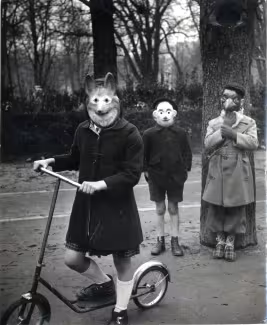
as part of the exhibition "Agnès Varda, Here and There: Paris-Rome"
Exhibition
-Villa Médicis, Rome
25 Feb. → 25 May
Photographer, filmmaker, and visual artist
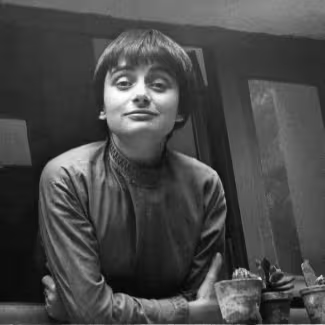
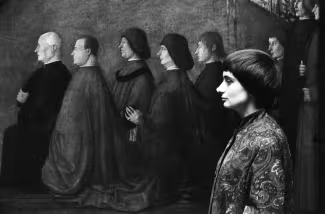
Born in Ixelles in 1928, Agnès Varda led three distinct lives: as a photographer, a filmmaker, and a visual artist. She grew up between Brussels and the Belgian beaches until May 10, 1940, when her family was forced to flee the German army. The family settled in Sète, living on a boat moored at the dock.
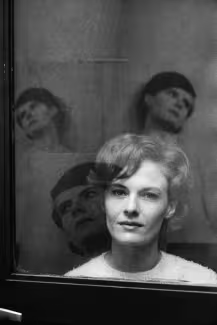
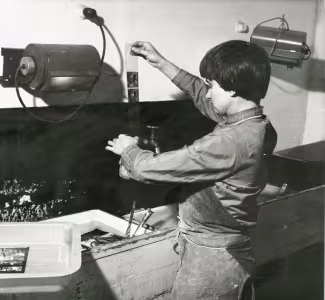
In 1943, the family moved to Paris, and Agnès Varda studied philosophy at the Sorbonne and art history at the École du Louvre. In 1949, she earned her CAP in photography after taking evening classes at the École de Vaugirard. In 1951, her father bought her some dilapidated old shopfronts on Rue Daguerre in the 14th arrondissement, which would become her home, studio, and darkroom. She photographed, among others, Brassaï, Calder, Dalí, Louis Aragon, Elsa Triolet, and Fellini.
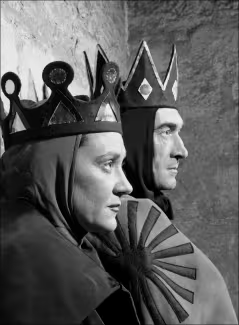
As early as 1948, Jean Vilar offered her a job as a photographer at the Avignon Festival, where she worked alongside him until 1960. She also covered the Théâtre National Populaire from 1951 to 1961, providing a comprehensive view of its activities—from stage designs, models, and portraits of actors to shots taken during rehearsals and performances. As a freelance photographer, Agnès Varda collaborated with Galeries Lafayette and the Société nationale des chemins de fer français (French National Railway Company) and produced various photo essays for magazines such as Realities .
At the same time, Agnès Varda was directing her first films and documentaries— La Pointe-Courte (1954), The Opéra-Mouffe (1958) and Cleo from 5 to 7 (1961) — and thus began his second life, bringing a breath of freedom to French cinema.
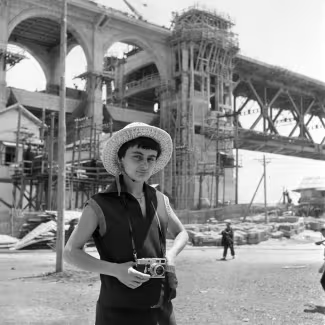
During his trips to Cuba and the United States, the photographer uses images as documents, depicting everything from Fidel Castro to the euphoria of dancers ( Hi, Cubans! , 1962–1963), or rebellious activists ( Black Panthers , 1968). His photojournalism covered China, Germany, and Portugal. Starting in the 1960s, his work as a photographer gradually gave way to his career as a filmmaker, which was recognized with an Honorary Oscar in 2017.
She returned to working with photography in the 2000s, notably for an exhibition at the Fondation Cartier titled The Island and Her . During this period, she developed her visual art through installations. In 2015, she met photographer JR, with whom she made the film Faces and Villages (2017).
Her documentary approach is intertwined with a natural sense of poetry. Her work as a photographer, filmmaker, and visual artist has given her the opportunity to create tirelessly, depicting her surroundings with both seriousness and imagination.
Exhibition
-Villa Médicis, Rome
25 Feb. → 25 May
Exhibition
-IMS, Sao Paulo
25 Nov. 2025 → 12 Apr. 2026
Exhibition
-Les Rencontres de la photographie d'Arles
3 Jul. → 24 Sep. 2023
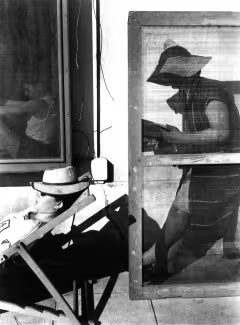
Exhibition
-Finnish Museum of Photography, Helsinki
13 May → 28 Aug. 2022
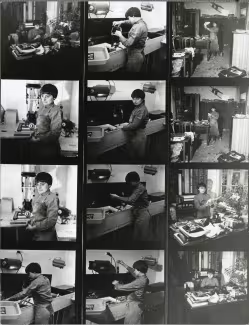
Exhibition
-Institut pour la photographie, Lille
→ PERSPECTIVES
8 Oct. → 5 Dec. 2021
→ PERSPECTIVES