Téo Becher
Biography
Téo Becher
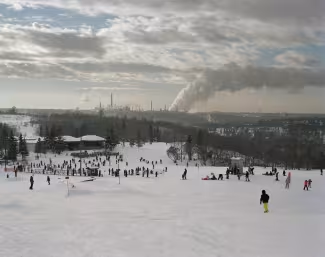
This project is taking place in the province of Alberta, Canada, primarily around the two cities of Edmonton and Calgary.
Alberta could be described as the “Canadian Texas”—a conservative, oil-producing province (Canada has the world’s third-largest oil reserves), consisting mainly of the Great Plains and rolling hills. The vast majority of Alberta’s oil operations are located in the far north of the province around the oil sands deposits—a type of oil found mixed with sand that must therefore be “cleaned,” making its extraction highly polluting.
The aim of this project is to explore lines of thought that I have developed in previous works concerning our relationship with nature, the separation between nature and culture, and the resulting exploitation of the landscape. Here, the Canadian landscape and the relationship people have with it appear as an extreme case of the ambivalence between the protection of nature and its exploitation. Gradually, the idea of focusing on the two cities of Edmonton and Calgary emerged because they represent a system of engagement with the capitalist world and exploitation that stands in stark contrast to the history of the territory that is now Canada and the Indigenous cosmologies that inhabit it. Furthermore, examining the city within the context of the Canadian landscape interests me because it runs counter to the image we have of Canada as an untouched and untouchable nature reserve; questioning these representations seems relevant to me, especially when viewed through the lens of the Western paradigm.
Canada is a colonial state founded on the exploitation of natural resources (the fur trade, mining, timber, oil, gas, uranium, etc.) which, at the same time, has served to justify the presence of colonists and continues today to reinforce the foundations of a cultural pride that is integral to Canadian identity. The prevalence and power of representations linked to oil in Albertan culture are striking, and this is in part what lies at the heart of this project. The idea is to trace these different threads—oil, settler colonialism, and the relationship to history—to see how all of this has shaped Canada today and to try to discern what it reveals about our relationship to the world and to nature.
Biography