Rebekka Deubner
Biography
Exhibition
The 20 July 2026
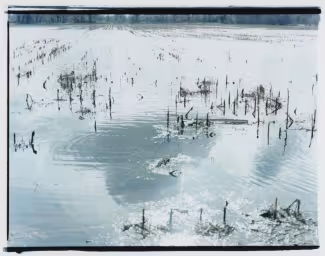
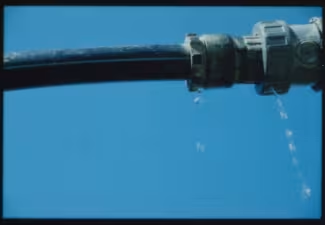
Winning project of the Institute for Photography Grant in 2025, "Love-struck earth" (a term used to describe dirt that sticks to boots) by the photographer Rebekka Deubner will be presented as an exhibition at the Rencontres d'Arles from July 6 to October 4, 2026.
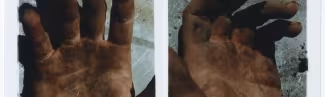
In March 2023, Rebekka Deubner traveled to Sainte-Soline, in the Deux-Sèvres department, to take part in protests against plans for mega-reservoirs. The violence of the crackdown was immediate, and the event was quickly reduced to sensational images and oversimplified narratives. Yet what was being overlooked seemed essential to her. It is to this space—off-camera—that she chooses to return, almost every month, from April 2023 to December 2025.
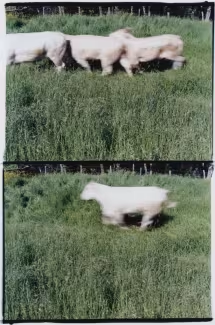
Traveling from north to south through the department as the seasons change, she shares in the daily lives of those who live and work on this land. Amandine, Martial, Valentin, Rémi, Benoit, and Jean-Jacques—livestock farmers, market gardeners, and environmental activists—introduce her to their practices, following the rhythm of ordinary, repetitive tasks: fencing, irrigating, weeding, sowing, harvesting, observing, and feeding. These are all actions that ground the body in the passage of time and shift our perspective, in contrast to the idealized images of Épinal.
Little by little, another landscape takes shape—one made up of cultivated plots, greenhouses, hedges, and ponds—stretching from the outskirts of the Sainte-Soline reservoir to the dried-up banks of the Mignon. Water—at once present and absent—serves as the common thread throughout this body of work, conceived as a long, continuous movement. It flows, is absent, stagnates, and then disappears. A vital resource and a political issue, it flows through the images without ever settling, as if to resist any simplification.
Closer than ever to the earth and the transformations that shape it, Rebekka Deubner situates the image within a shared experience. It does not precede the relationship; it arises from it. Rather than explaining or convincing, this work focuses on what resists demonstration: long-term temporalities, repetition, and the forms of attention that make engagement possible. The image is no longer the center of this, but rather one of its effects.

Biography