Guillaume Blanc-Marianne
Biography
Image

Recherche & création
During the 1960s and 1970s, in France, the focus was on the new “audiovisual” paradigm. The association Gens d’images, founded by Albert Plécy in 1954 and bringing together those who sought social recognition equivalent to that of “people of letters,” set out to captivate the public with a series of installations in the form of “walls of images.”
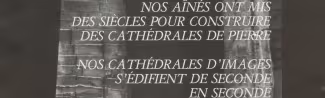
During this visual discussion, we will revisit some of their achievements (such as the Night of the Image in 1967, the 24 Hours of Images in 1969 or the Bestiary (2000 and 1970), culminating in Albert Plécy’s major work, the Cathedral of Images in Les Baux-de-Provence, which was inaugurated in a limestone quarry in the Val d’Enfer in 1977.
Conceived as a permanent exhibition, it invites the viewer to navigate “within” the image—that is, within a space that is, so to speak, visceral—in which the viewer is surrounded by monumental projections designed to capture their attention and produce an aesthetic and cognitive shock. In this sense, and as its name suggests, the Cathedral of Images deserves to be examined over the long term, for example in comparison with medieval practices of collective image consumption. It also certainly deserves to be evaluated in light of contemporary critiques of the culture industry, given that Plécy’s discourse regarding his project can at times take on a domineering, if not tyrannical, tone.
In short, we will attempt to understand how the *Cathedral of Images* is also conceived as the culmination of the “civilization of the image,” an idea that began to spread in France in the 1950s and theorized the end of the era of the text, ushering in that of the image, with all that this implies: photography regarded as a universal language; convenient and rapid communication, calibrated to the model of the commercial world; a world now perceived solely through its visual rather than conceptual representations.
Biography