Mazaccio-Drowilal Collective
Biography
Image

Rencontre
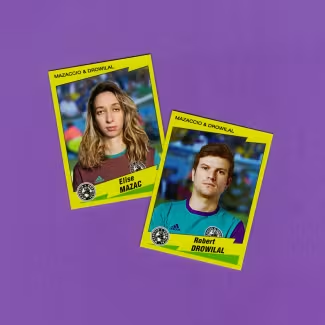
Elise Mazac, also known as Mazaccio (1988), and Robert Drowilal (1986) are two French artists working under the name Mazaccio & Drowilal. Both influenced by conceptual art, Pop Art, and the Pictures Generation, they create para-photographic works based on the principle of “collimage.” Their work addresses various themes such as celebrity, brand image, and identity.
In 2013, the duo was awarded the 3rd BMW Residency at the Nicéphore Niépce Museum. In 2017, they were artists-in-residence at the International Studio & Curatorial Program (ISCP) in New York.
Their work has been featured in solo exhibitions at the Rencontres d’Arles (2014), the French Institute in New York (2015), Les Abattoirs, Toulouse (2018), at the Musée des Beaux-Arts in La Chaux-de-Fonds (2021), and in group exhibitions at Galleria Continua in Les Moulins, the Musée Nicéphore Niépce, and the Palais des Beaux-Arts in Paris.
At the same time, they have published numerous artist’s books, including *Wild Style* (Camera, 2014), *Champagne* (RVB Books, 2015), *The*Happiness Project (RVB Books, 2018), Paparazzi (RVB Books, 2021), and*Iconology* (RVB Books, 2024).
They are visiting lecturers at the Lausanne Cantonal School of Art (ECAL) in Switzerland.
With their research project titled “Paravent Pictures,” Mazaccio & Drowilal are among the winners of the 6th edition of the Institut pour la photographie’s research and creation support program, dedicated to historical and theoretical studies or creative research on image walls.
As artists, Mazaccio & Drowilal are interested in what forms the backdrop of our lives: the images produced by consumer society, their abundance, and the ways they are disseminated.
What narratives do they convey? How do they shape our worldviews and identities? To explore the concept of a “wall of images,” they use the folding screen as the subject of their artistic experimentation. Drawing on various disciplines—ranging from art history to visual studies, anthropology, psychoanalysis, and communication theories—they explore the construction of icons androle models, as well as the concepts of persona and extimacy, which are intrinsically linked to them.
Biography