Introduction to L is for Look
as part of Paris Photo 2024
Event
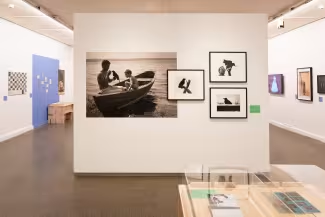
Co-produced by the Institut pour la photographie and Photo Elysée, L is for Look - R for Watching - is an exhibition dedicated to the history of children's photo books. It features more than a hundred albums written and published in various countries.
At the 2024 edition of Paris Photo, the Institut pour la photographie presented, for the first time, some of the interactive elements that will be featured in the upcoming exhibition.
From its rise—marked as early as the 1930s by the emergence of new educational methods focused on images rather than text—to the present day, the children’s photo book has embraced the realistic nature of the photographic image. Spanning the full spectrum of children’s literature—from alphabet books to reinterpretations of traditional fairy tales—it supports children in their development and empowerment, and stimulates their creativity, all with a shared goal: to challenge and enrich their perspective on the world.
This editorial genre, explored by leading figures in photography, is a field in which women photographers are particularly prominent. It is also distinguished by the diversity of disciplines it draws upon, such as the graphic arts, design, and the performing arts.
The Exhibition L is for Look will be the subject of a European tour that will begin in September 2025 at Photo Elysée in Lausanne and continue through 2028 at the Institut pour la photographie, after being presented at five partner institutions: the Museum Folkwang in Essen, the Rencontres de la Photographie d’Arles, the Photographers’ Gallery in London, the National Audiovisual Center (CNA) in Luxembourg, and FOTO ARSENAL in Vienna.
Programmes
↘︎ All About William Wegman's Books
A presentation of a selection of his works and an original large-format Polaroid print ( William Wegman, *Anette*, 1992. Color Polaroid, 20 x 24 inches. Courtesy of Galerie Georges-Philippe and Nathalie Vallois, Paris ) allowed us to explore different ways of staging these portraits and to examine the line between the photographer’s direction and the dogs’ collaboration. What shooting techniques are used, what emotions emerge, and how does the composition incorporate props and sets?
The booth also featured an introduction to this print through an audio description created for the occasion in collaboration with the Belgian nonprofit organization PAF (French-speaking audio description professionals). Beyond its use by people with visual impairments, audio description—both in its written form and when listened to—offers an opportunity to engage with an image through means other than sight.
↘︎ About the book *What Do You See?* (Kaléidoscope, 2003) by Tana Hoban
An interactive installation incorporated Tana Hoban's invitation in What do you see? / Look again! to explore how different framing techniques influence our perception of photographs and our surroundings. A feature integrated into the gallery’s picture rail invited visitors to sharpen their observation skills through a game of spotting details and textures. What senses, beyond sight, can be associated with an image as it is captured? What recurring motifs make up our visual environment? A Kamishibai—a Japanese picture-story show—allowed visitors to explore the narrative potential of a series of images, revealing how their sequence and the words (and music!) used to describe them create new visual stories.
↘︎ About the book *Animaux à mimer* (MeMo, 2010) by Alexandre Rodchenko, Serge Tetriakov, and Varvara Stepanova
An interactive mini-studio gave visitors the chance to try their hand at staging and photographing paper animals from the project Samozvieri / Animals to Imitate. Following the prompt from the book by Alexander Rodchenko and Varvara Stepanova, you were to bring these paper characters to life by playing with the light in the mini-studio, the shadows cast, and various angles of view. These scenes could be inspired by excerpts from Serge Tetriakov’s poem or created freely. One of the iconic characters designed by Rodchenko and Stepanova—the life-size ostrich—was on display at the booth.
↘︎ About the book *À toi de jouer!* (Les Grandes Personnes, 2010) by Claire Dé
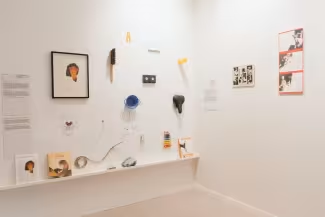
In Now it's your turn, Through photography, Claire Dé transforms a collection of everyday objects in shades of orange and yellow, creating a unique world of shapes, textures, and flavors. The artist made some of her multicolored tableware available so that visitors could, in the mini-studio, compose their own creations and use photography to give the objects a sculptural quality. Once the sculpture was assembled, participants could enhance it, assign it a new function, alter its scale, and give it a title, thereby reinventing its meaning.
↘︎ About the book *Clic Clac* or *What Is It?* (published by L’École des Loisirs, 1989) by Tomi Ungerer
The booth invited visitors to try their hand at the same game on a wall featuring three-dimensional everyday objects. Using the same principle, participants could bring other fantastical creatures to life with pencil strokes, drawing from a library of images or magazine clippings. A tactile version of Tomi Ungerer’s collage was also displayed alongside the original at the booth. This installation, developed in partnership with the Laville Braille printing house and originally designed for people with visual impairments, challenges our perception and interpretation of images: should every detail be conveyed? How do we convey depth of field? Colors? Textures? Which details are significant, and which ones can be downplayed?